Ethylene: Singlet–Triplet Crossing (MECP)
A minimum-energy crossing point (MECP) is the lowest-energy geometry at which two states of different spin multiplicity have the same energy. It is where intersystem crossing between a singlet and a triplet is most likely, and the spin-orbit coupling there sets how fast the crossing happens. This example finds the S0/T0 MECP of ethylene with MRSF-TDDFT and computes the spin-orbit coupling at that point.
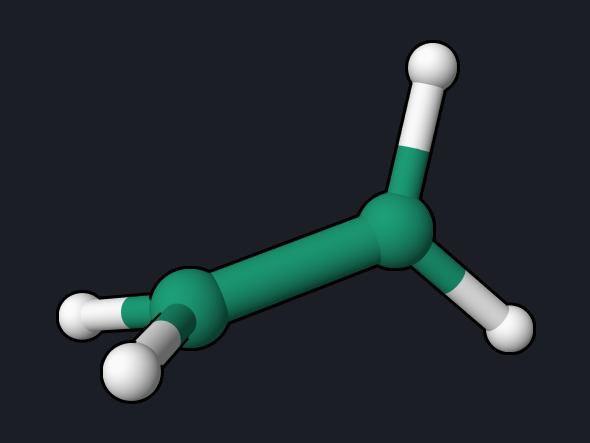
Step 1: locate the MECP
mrsf(nstate=5)/bhhlyp/6-31g* mecp(S0,T0)
geom="""
C      0.000000     0.000000     0.664311
C      0.000000     0.000000    -0.664311
H      0.000000     0.923944     1.237411
H      0.000000    -0.923944     1.237411
H      0.923944     0.000000    -1.237411
H     -0.923944     0.000000    -1.237411
"""
openqp ethylene-mecp.oqp
mecp(S0,T0) searches for the lowest point where the singlet S0 and the
triplet T0 cross. MRSF-TDDFT gives both states from the same calculation. The
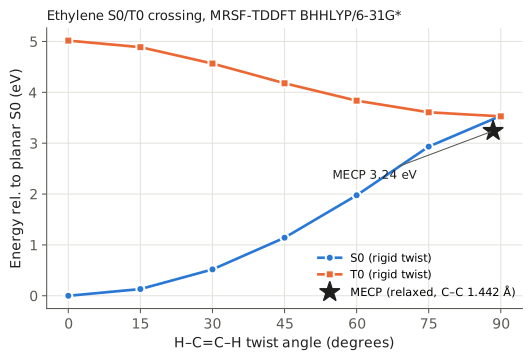
start is the rigidly twisted ethylene of the twist example,
where T0 lies 0.01 eV below S0. The default algorithm is SQP (sequential
quadratic programming), which solves for the step and the gap constraint
together:
   PyOQP mecp search algorithm:                   sqp
   PyOQP: Geometry Optimization Has Converged
The search converges in 9 steps, in about 17 seconds.
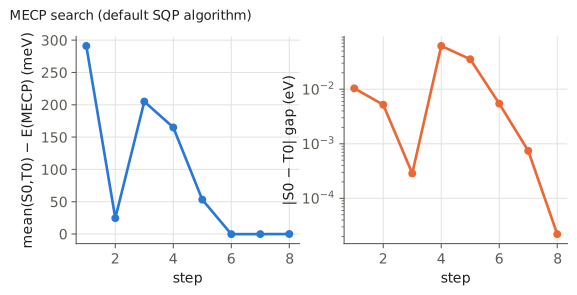
The plot uses the S0 and T0 energies printed for each step in the log. (In
OpenQP 1.3.1 the step table in opt_status.txt shows −78.52136 hartree at step
4, which does not correspond to any computed state energy; the computed S0 and
T0 at that step are −78.40170 and −78.39942 hartree.)
The final ENERGIES AND STATES block lists the five singlets followed by the
five triplets. In OpenQP 1.3.1 the triplets are printed with the labels S5–S9;
S5 is T0:
   PyOQP S0                                 -78.4066167269
   PyOQP S1                                 -78.3101111447
   ...
   PyOQP S5                                 -78.4066167255
| Quantity | Reference value |
|---|---|
| E(S0) = E(T0) at the MECP | −78.4066167 hartree |
| Energy above the planar S0 minimum | 3.24 eV |
| r(C–C) | 1.442 Å (1.328 Å at the planar minimum) |
| Twist between the CH₂ planes | 88.4° |
| CH₂ groups | planar (sum of angles at each C: 360.0°) |
Step 2: spin-orbit coupling at the MECP
mrsf(nstate=3)/bhhlyp/6-31g* soc
geom="""
C      0.000000     0.000000     0.720836
C      0.000000     0.000000    -0.720836
H      0.012804     0.917650     1.291709
H     -0.012804    -0.917650     1.291709
H      0.917650     0.012804    -1.291709
H     -0.917650    -0.012804    -1.291709
"""
Download ethylene-mecp-soc.oqp
The run takes about 3 seconds. The S0–T0 coupling:
     S0    / T0(Ms=-1)       0.0000      0.0000     -0.0000     -0.0000    0.000000000000
     S0    / T0(Ms= 0)       0.0000      0.4611      0.0000     -0.2325    0.228619235459
     S0    / T0(Ms=+1)       0.0000     -0.0000     -0.0000      0.0000    0.000000000000
and the spin-orbit states at the crossing:
  State    cm-1        eV        Composition

     1       -0.23   -0.000028    T0( 0) ( 50.7%)         S0 ( 49.3%)
     2       -0.00   -0.000000    T0(+1) ( 50.0%)     T0(-1) ( 50.0%)
     3       -0.00   -0.000000    T0(-1) ( 50.0%)     T0(+1) ( 50.0%)
     4        0.23    0.000029        S0 ( 50.7%)     T0( 0) ( 49.3%)
Reading the result
- Relaxation lowers the crossing. With rigid bond lengths, S0 and T0 meet near 90° at about 3.53 eV. Letting the C–C bond stretch to a single-bond length of 1.442 Å brings the crossing down to 3.24 eV.
- The spin-orbit coupling is tiny. Only the Ms = 0 component couples, by 0.23 cm⁻¹. Because S0 and T0 are degenerate at the MECP, even this small coupling mixes them 50:50, but the splitting it produces is only 0.46 cm⁻¹. For comparison, in formaldehyde, where n and π orbitals change between the coupled states, the couplings are about 50 cm⁻¹ (see the SOC example). In a light hydrocarbon with only π-type states, singlet–triplet crossing is slow.
Try next
- Search for the S1/T1 crossing of formaldehyde with
mecp(S1,T1)from the geometry of the SOC example, and compute the SOC there. - Start the ethylene search from a pyramidalized structure and check whether it finds the same MECP.
See also: Optimization (MECP algorithms), Spin-Orbit Coupling, conical intersection example.