Formaldehyde in Water: QM/MM Solvent Shift
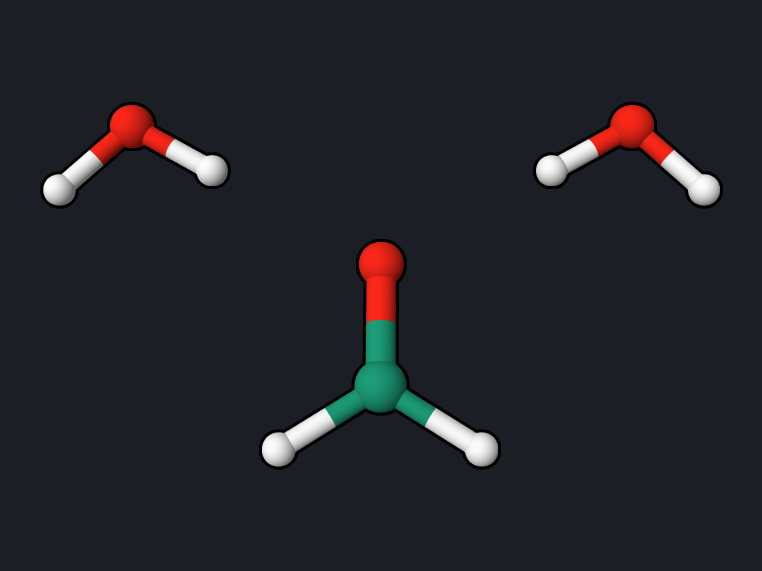
In QM/MM, a small quantum (QM) region is embedded in a classical (MM) environment. Here formaldehyde is the QM region, and two water molecules that hydrogen-bond to its oxygen are TIP3P point charges. The example computes how the environment shifts the n→π* excitation energy, and checks the QM/MM result against a calculation that treats the whole cluster quantum mechanically.
Requirements
QM/MM uses the OpenMM library for the MM part. Install it into the same Python environment as OpenQP:
pip install openmm
The reference values were produced with OpenMM 8.3.1.
Copy and run
QM/MM needs the structure as a PDB file and the force-field files. Download all four files into one folder:
- formaldehyde-qmmm.oqp, the input
- formaldehyde_2water.pdb, formaldehyde (atoms 0–3) and two waters
- formaldehyde.xml, Lennard-Jones parameters for the QM molecule
- tip3p.xml, the TIP3P water model
mrsf(nstate=3)/bhhlyp/6-31g* namd(S1,scheme=BaeckAn) md(nstep=1,dt=0.5,velocity=zero)
qmmm(forcefield_files="formaldehyde.xml tip3p.xml",qm_atoms="0-3",cutoff=NoCutoff)
geom="formaldehyde_2water.pdb"
openqp formaldehyde-qmmm.oqp
qmmm(...):qm_atoms="0-3"makes the first four PDB atoms (0-based) the QM region; everything else is MM.cutoff=NoCutoffincludes all MM charges.- The PDB file is the geometry. OpenQP builds the QM molecule from the selected atoms.
namd(S1,...) md(nstep=1,dt=0.5,velocity=zero): in OpenQP 1.3.1 the electrostatic embedding is built by the QM/MM dynamics and optimization drivers, not by a plain single-point energy. A single step started at rest is the supported way to obtain the embedded energies of all three states at this structure. The log notes that the ESPF embedding charges are taken from the relaxed density of the active state, S1.
The run takes about 5 seconds.
For comparison, the same formaldehyde coordinates in the gas phase (formaldehyde-gas.oqp) and the full formaldehyde + 2 water cluster treated entirely by MRSF-TDDFT (formaldehyde-2water-qm.oqp):
mrsf(nstate=3)/bhhlyp/6-31g*
geom="""
C      0.000000     0.000000    -0.526000
O      0.000000     0.000000     0.676000
H      0.000000     0.938000    -1.120000
H      0.000000    -0.938000    -1.120000
"""
What you get
The log prints an excited-state summary table at every step. The first one is at the input structure, before the atoms move, and is the value to compare with the other two models:
 State      Energy       Excitation   Excitation(eV)  <S^2>         Transition dipole moment, a.u.        Oscillator
           Hartree           eV        rel. S0                  X          Y          Z        Abs.      strength
    S0   -115.1678881025    -3.219474     0.000000      0.002     0.0000     0.0000     0.0000     0.0000      0.0000
    S1   -115.0129908096     0.995496     4.214970      0.007    -0.0000     0.0000     0.0002     0.0002      0.0000
velocity=zero only sets the initial velocities; the forces still move the
atoms during the 0.5 fs step, so the last ENERGIES AND STATES block of the
log (S1 − S0 = 4.220 eV) belongs to a slightly displaced structure. The
absolute energies include the QM–MM interaction and are not comparable with
the gas-phase energies; the excitation energy S1 − S0 is.
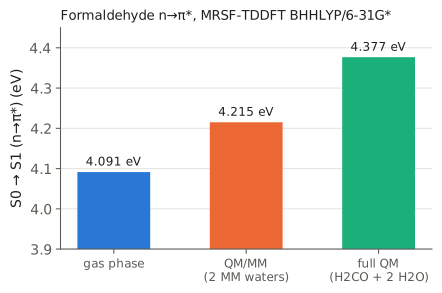
| Model, same structure | S0 → S1 (n→π*) | Shift from gas phase |
|---|---|---|
| Gas phase | 4.091 eV | — |
| QM/MM, 2 TIP3P waters | 4.215 eV | +0.12 eV |
| Full QM, formaldehyde + 2 waters | 4.377 eV | +0.29 eV |
In all three runs S1 is the dark A2 n→π* state (zero transition dipole), so the numbers describe the same excitation.
Reading the result
- The excitation is blue-shifted. The water hydrogens bind to the oxygen lone pair n, lowering its energy. Exciting an electron out of n therefore costs more in the hydrogen-bonded complex than in the gas phase.
- Point charges give less than half of the shift here (0.12 of 0.29 eV). The QM/MM model represents the waters only by fixed charges (and Lennard-Jones terms), while the full QM cluster also includes the polarization of the waters and the exchange and charge-transfer interactions at 1.95 Å. For quantitative work, include the first-shell waters in the QM region and keep more distant solvent as MM.
- Two waters at one fixed structure are a model, not a solution: a solvent shift for comparison with experiment needs averaging over many solvent configurations, for example snapshots from QM/MM dynamics.
Try next
- Add more TIP3P waters to the PDB file around the molecule and watch the QM/MM shift change.
- Run ground-state QM/MM dynamics with
md(...)and the sameqmmm(...)call (see the qmmm keyword page), then compute the shift on several snapshots.
See also: qmmm,
SOC-NAMD-QMMM,
repository QM/MM examples.