Benzene: Molecular Symmetry
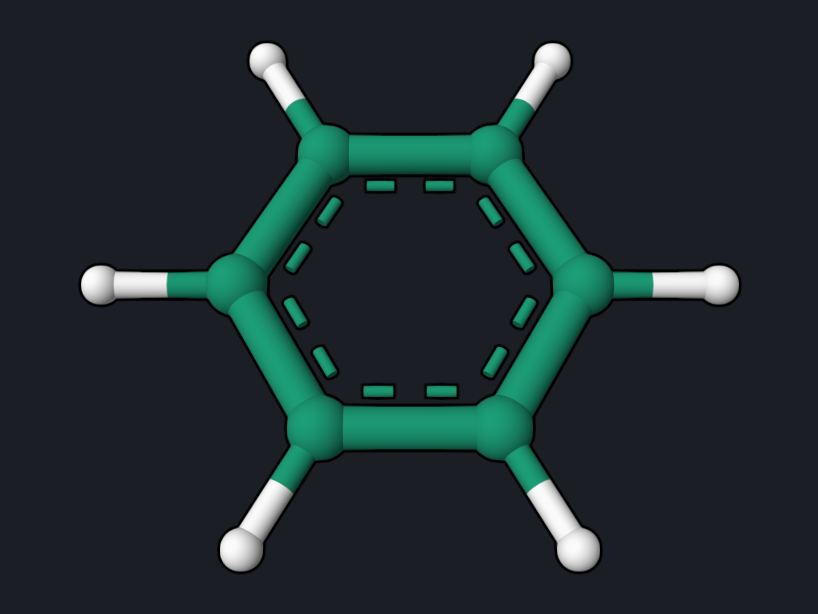
OpenQP detects the point group of every input structure automatically. It uses the symmetry to label orbitals, states, and vibrations, and to skip integrals that are related by symmetry. Nothing has to be requested; this example shows what the detection reports and how much time it saves for benzene.
Copy and run
hf/cc-pvtz
geom="""
C      1.392883     0.000000     0.000000
C      0.696465     1.206259     0.000000
C     -0.696465     1.206259     0.000000
C     -1.392883     0.000000     0.000000
C     -0.696465    -1.206259     0.000000
C      0.696465    -1.206259     0.000000
H      2.479666     0.000000     0.000000
H      1.239913     2.147463     0.000000
H     -1.239913     2.147463     0.000000
H     -2.479666     0.000000     0.000000
H     -1.239913    -2.147463     0.000000
H      1.239913    -2.147463     0.000000
"""
Download benzene-hf-sym.oqp ·
benzene-hf-nosym.oqp (the same input with
symmetry(enabled=false) added to the first line)
openqp benzene-hf-sym.oqp
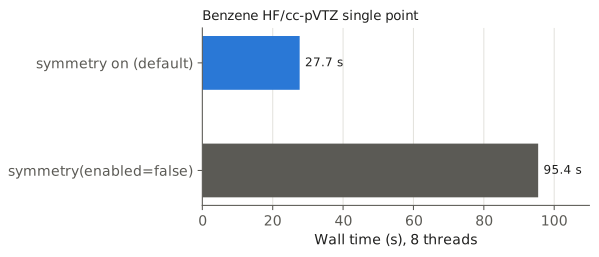
A Hartree–Fock single point with 264 basis functions (cc-pVTZ). With 8 threads the run takes 28 seconds with symmetry and 95 seconds without.
What you get
The log starts with the symmetry metadata:
   PyOQP symmetry status:                      enabled
   PyOQP symmetry detected point group:        d2h
   PyOQP symmetry label MO:                    yes
   PyOQP symmetry use integral symmetry:       yes
   PyOQP symmetry tolerance:                   1e-05
and the integral setup reports integral reduction : active (|G| = 8, abelian
subgroup) with symmetry and skipped_no_detection without it. Each orbital
then carries its symmetry label:
   point group:      d2h
   SCF state:        1AG
   alpha MOs:
      ...
      19       -0.49236470  ag
      20       -0.33561499  b2g
      21       -0.33559202  b3g
      22        0.12872521  au
| Symmetry on (default) | symmetry(enabled=false) |
|
|---|---|---|
| Energy | −230.7791170133 hartree | −230.7791170135 hartree |
| SCF iterations | 9 | 9 |
| Wall time (8 threads) | 27.7 s | 95.4 s |
Reading the result
- Same answer, 3.4 times faster. Using the eight operations of D2h, OpenQP computes only the symmetry-unique two-electron integrals; the energies agree to 2 × 10⁻¹⁰ hartree.
- Labels come with the run. The two highest occupied orbitals, 20 (b2g) and 21 (b3g), differ in energy by only 2 × 10⁻⁵ hartree: they are the two components of the degenerate π orbital pair of benzene, labelled in the abelian subgroup D2h that OpenQP uses.
- Detection uses a tolerance (
symmetry tolerance: 1e-05in the log), so the coordinates must be symmetric to that precision; for these coordinates, rounded to six decimals after an optimization, OpenQP reports D2h. Starting from symmetric coordinates keeps the symmetry through an optimization, as in the water and formaldehyde examples. - Symmetry speeds up the integral-heavy parts; the TDDFT response steps of the
UV example do not use it (
use response symmetry: no). A benzene TDDFT run took 20.8 s with and 20.9 s without symmetry.
Try next
- Add
symmetry(enabled=false)to another input and compare the run time. - Start from exactly symmetric coordinates (for example, generated from bond lengths and angles) and check the detected group in the log.
See also: Molecular Symmetry,
symmetry keywords.