Ethylene: Coupling Between Two Geometries (NACME)
Surface-hopping dynamics needs the coupling between electronic states along the trajectory. The NACME (nonadiabatic coupling matrix element) workflow obtains it from two nearby geometries: it computes the overlaps of the electronic states at the two structures and turns them into a time-derivative coupling. This example takes two consecutive frames from the ethylene NAMD trajectory, 0.5 fs apart, just before the hop to S0.
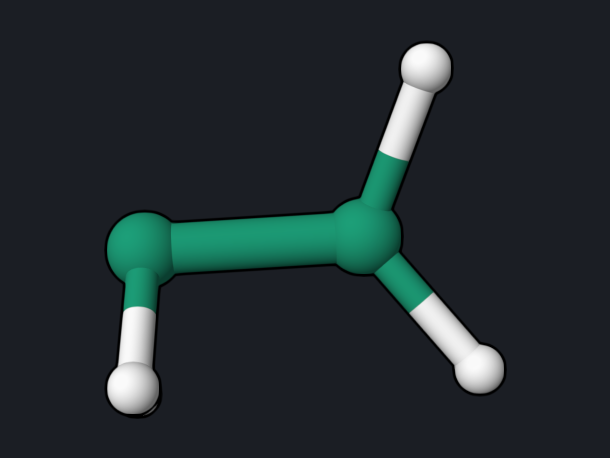
Copy and run
mrsf(nstate=3)/bhhlyp/6-31g nacme(S0,S1)
geom2="""
C     -0.064618    -0.221999     0.675181
C      0.008847     0.342365    -0.693621
H     -0.897526     0.258489     1.326593
H      0.271183    -1.193629     1.028019
H     -0.000944    -0.618553    -1.099719
H      1.291351     0.120517    -1.035329
"""
geom="""
C     -0.063015    -0.217408     0.666522
C      0.006888     0.342791    -0.685095
H     -0.922484     0.251033     1.304645
H      0.320438    -1.208096     1.024800
H     -0.015385    -0.622076    -1.118494
H      1.285729     0.086223    -0.989812
"""
openqp ethylene-nacme.oqp
nacme(S0,S1) requests the coupling matrix; geom2 is the earlier structure
(t = 100.5 fs) and geom the later one (t = 101.0 fs). Both are given inside
the input. The run takes about 4 seconds.
What you get
The log prints the state overlaps between the two geometries, the derivative coupling, the energy gaps, and the nonadiabatic coupling:
   PyOQP: phase corrected state overlap (s_ij)
      0.82885303       0.55690871       0.00264817
     -0.54636930       0.82540781      -0.00484133
     -0.00118345      -0.01044068       0.99716901
   PyOQP: phase corrected derivative coupling (d_ij)
      0.00000000       0.55163901       0.00191581
     -0.55163901       0.00000000       0.00279967
     -0.00191581      -0.00279967       0.00000000
   PyOQP: state energy gap (e_ji)
      0.00000000       0.00834302       0.16127661
Rows and columns are S0, S1, S2. The printed coupling is d_ij = (s_ij − s_ji)/(2Δt) with Δt = 1, so d is dimensionless: for example d(S0,S1) = (0.55690871 + 0.54636930)/2 = 0.55163901. (The log header writes the formula without the factor 2, but the printed values include it.) Divide by the time step in atomic units (0.5 fs = 20.67 a.u.) to obtain the time-derivative coupling.
| Quantity | Reference value |
|---|---|
| ⟨S0(t) | S0(t+Δt)⟩ | 0.829 |
| ⟨S0(t) | S1(t+Δt)⟩ | 0.557 |
| d(S0,S1) | 0.552 (0.0267 a.u.⁻¹ per 0.5 fs) |
| S1 − S0 gap | 0.0083 hartree (0.23 eV) |
| d(S1,S2) | 0.003 |
Reading the result
- The states mix strongly within 0.5 fs. An overlap of 0.56 between S0 at one step and S1 at the next means that the electronic character changes substantially between the two frames; the trajectory is passing close to the S0/S1 intersection.
- The coupling is large where the gap is small. d(S0,S1) = 0.55 at a gap of 0.23 eV, while S2, 4.4 eV higher, couples by only 0.003.
- This is the quantity a surface-hopping run evaluates at every step with the overlap-based coupling schemes (see NAMD coupling schemes).
Try next
- Compute the analytic NAC vector at one of the two geometries with
nac(S0,S1,type=analytical), as in the MECI example, and compare its direction with the motion between the frames.
See also: NACME, ethylene NAMD.