Formaldehyde in Water: QM/MM Excited-State Dynamics
This example combines the QM/MM model with surface-hopping dynamics: formaldehyde (QM, MRSF-TDDFT) is excited to its n→π* state S1 while hydrogen-bonded to two TIP3P waters (MM), and both the QM molecule and the waters move for 100 fs. The trajectory shows how the excited molecule changes shape and how its hydrogen bonds respond.
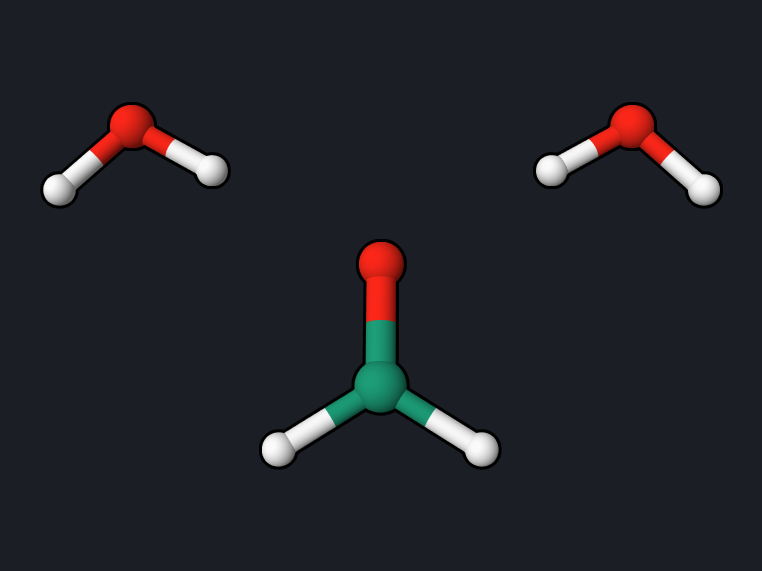
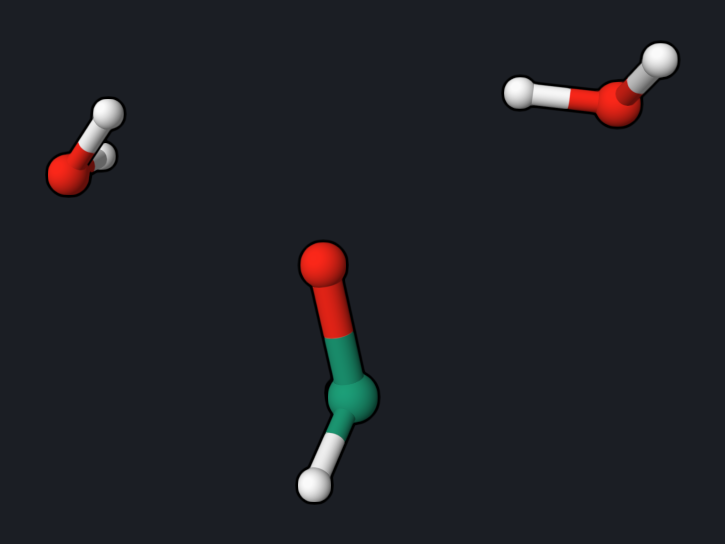
Copy and run
Download the input and the three structure and force-field files of the
QM/MM example into one folder:
formaldehyde-qmmm-namd.oqp,
formaldehyde_2water.pdb,
formaldehyde.xml, and
tip3p.xml. OpenMM is required (pip install openmm).
mrsf(nstate=3)/bhhlyp/6-31g* namd(S1,scheme=BaeckAn) md(nstep=200,dt=0.5,temperature=300,seed=5)
qmmm(forcefield_files="formaldehyde.xml tip3p.xml",qm_atoms="0-3",cutoff=NoCutoff)
geom="formaldehyde_2water.pdb"
openqp formaldehyde-qmmm-namd.oqp
Compared with the single-structure QM/MM run, only
md(...) changes: 200 steps of 0.5 fs with initial velocities for all ten atoms
drawn at 300 K (seed=5 makes the run reproducible). namd(S1,...) starts the
trajectory on S1 and allows hops among the three states. The run takes about
5 minutes with 8 threads.
What you get
Each step prints one line to the log, marked QMMM-NAMD:
   QMMM-NAMD step      0  t=    0.000 fs  active=2  E_tot=-114.26382638  E_pot=-114.27380184 ...
   QMMM-NAMD step    200  t=  100.000 fs  active=2  E_tot=-114.26386569  E_pot=-114.28477464 ...
active=2 means S1 (1 = S0). The full trajectory is in
formaldehyde-qmmm-namd.namd.trj, with the coordinates of all QM and MM atoms;
read it with read_namd_trajectory as shown in the
ethylene NAMD example.
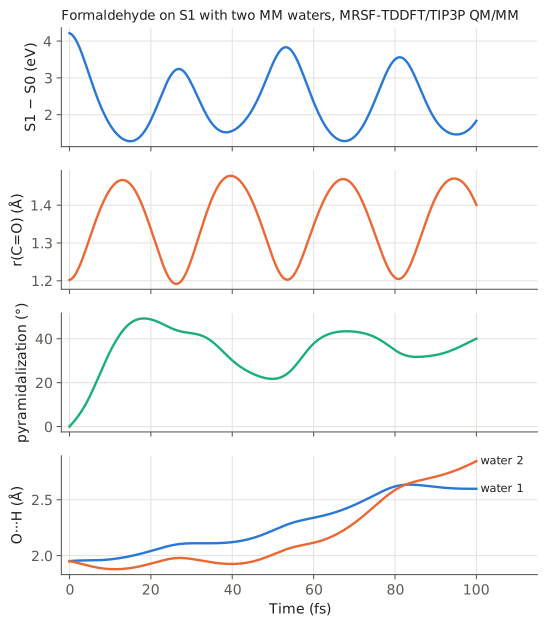
| Quantity | Reference trajectory |
|---|---|
| Active state | S1 for all 100 fs (no hops) |
| Total-energy range | 8.8 × 10⁻⁵ hartree (0.002 eV) |
| r(C=O) | oscillates between 1.19 and 1.48 Å (1.20 Å at the start) |
| Out-of-plane angle of O | 0° at the start, between 22 and 49° after 10 fs |
| O···H hydrogen bonds | 1.95 Å at the start, 2.60 and 2.85 Å at 100 fs |
| S1 − S0 gap | 4.21 eV at the start, between 1.3 and 3.8 eV afterwards |
Reading the result
- The excited molecule changes shape. In the n→π* state one electron moves from the oxygen lone pair into the C=O π* orbital. The C=O bond weakens and starts a large stretching vibration, and the molecule pyramidalizes within 20 fs. Both are known features of the S1 state of formaldehyde, whose equilibrium structure is pyramidal with a longer C=O bond.
- The hydrogen bonds break. With one electron removed from the lone pair, the oxygen is a weaker hydrogen-bond acceptor, and both waters drift away from 1.95 to 2.6–2.9 Å within 100 fs. This is the dynamical counterpart of the blue shift in the QM/MM example: the solvent stabilizes S0 more than S1.
- The gap oscillates with the C=O stretch and does not close. S1 of formaldehyde does not reach a crossing with S0 on this timescale, so no hop occurs; formaldehyde's S1 is long-lived compared with this simulation.
- One trajectory with two waters is an illustration. A solvated simulation needs a full solvent box and an ensemble of trajectories from sampled initial conditions.
Try next
- Run the same trajectory without
qmmm(...)and with the formaldehyde coordinates only, and compare the pyramidalization. - Add more waters around the molecule in the PDB file, or use the larger
repository systems in
examples/QMMM, which also show restraints that keep the solvent together.
See also: SOC-NAMD-QMMM,
qmmm, NAMD coupling schemes.