Hydrogen Iodide: Effective Core Potentials
An effective core potential (ECP) replaces the inner electrons of a heavy atom by a potential, so only the valence electrons are treated explicitly. This makes calculations on heavy elements much cheaper, and an ECP fitted to relativistic atomic calculations also brings in the scalar relativistic effects (see the gold hydride example). In OpenQP an ECP is selected simply by choosing a basis set that comes with one, such as def2-SVP for iodine.
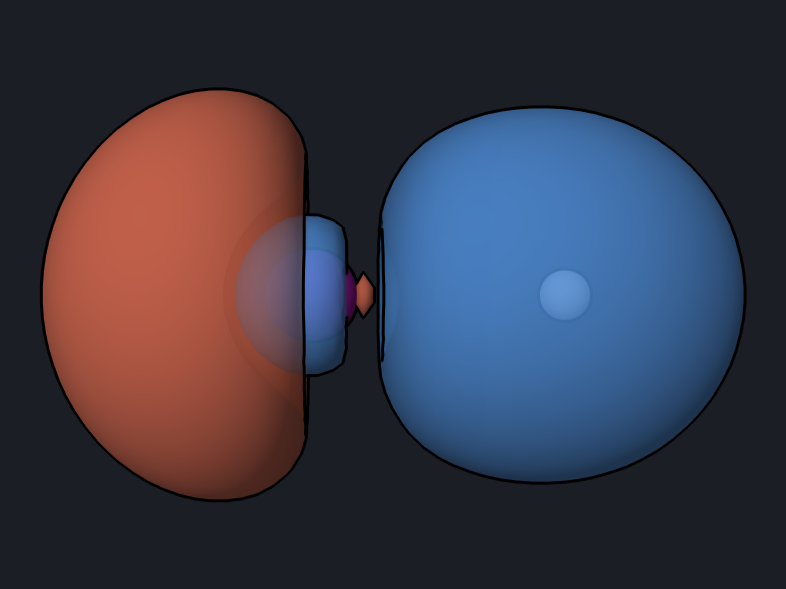
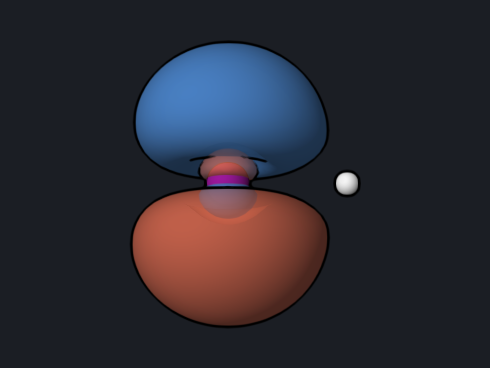
Step 1: optimize the geometry
dft/pbe0/def2-svp opt
geom="""
I 0.000000 0.000000 0.000000
H 0.000000 0.000000 1.600000
"""
openqp hi-opt.oqp
def2-SVP uses a 28-electron ECP for iodine: of the 53 electrons of the iodine atom, the 1s–3d shells (28 electrons) are replaced, and the 25 electrons of the 4s, 4p, 4d, 5s, and 5p shells remain. The log shows the reduced count and the size of the basis:
     Basis Sets: def2-svp
     Number of Basis Set functions  =      31
 DFT: number of electrons    =        26
The optimization converges in 4 steps, in about 5 seconds:
    3    -298.30701471      -0.00004109       0.006140       0.010635       0.000033       0.000057
    4    -298.30701472      -0.00000001       0.000088       0.000153       0.000000       0.000001
Step 2: frequency and dipole
At the optimized geometry, an analytic Hessian works with the ECP:
dft/pbe0/def2-svp hess(S0,type=analytical)
geom="""
I 0.000000 0.000000 -0.011754
H 0.000000 0.000000 1.611754
"""
Download hi-freq.oqp ·
hi-dipole.oqp (same geometry, first line
dft/pbe0/def2-svp properties(scf_prop="el_mom,mulliken"))
properties(...) is not applied in a Hessian run, so the dipole moment comes
from a separate single point. Each run takes a few seconds.
What you get
| Quantity | PBE0/def2-SVP (ECP) | Experiment |
|---|---|---|
| Energy (valence electrons only) | −298.3070147 hartree | — |
| r(H–I) | 1.624 Å | 1.609 Å |
| Harmonic frequency | 2230 cm⁻¹ | 2309 cm⁻¹ |
| Zero-point energy | 0.00508 hartree | — |
| Dipole moment | 0.660 D | 0.448 D |
| Mulliken charges | I −0.088, H +0.088 | — |
Reading the result
- The energy is a valence-only energy. −298.3 hartree is far from the all-electron energy of HI (about −6900 hartree without relativity); ECP total energies can be compared only with other calculations that use the same ECP. Reaction energies, geometries, and frequencies are what an ECP calculation is for.
- The bond length is 0.015 Å long and the frequency 79 cm⁻¹ low compared with experiment, which is typical for a double-zeta basis set; def2-TZVP uses the same ECP and is the natural next check.
- The dipole is small and sensitive. HI is only weakly polar, and the computed 0.660 D is 0.21 D above experiment; dipole moments usually need larger basis sets with diffuse functions.
- The orbitals come from the Molden file
hi-dipole_scf_rhf_pbe0_def2-svp.moldenas usual. Only the 13 valence orbitals are occupied; the core orbitals of iodine are not part of the calculation.
Try next
- Compare HBr with def2-SVP (bromine has no ECP in def2, so all 35 electrons are treated) and HI with def2-TZVP.
- Use an ECP with an excited-state method: the repository contains MRSF-TDDFT
and SF-TDDFT examples with ECPs in
examples/ECP.
See also: AuH: relativistic bond contraction, Examples.